Minskip
Network cabling for a gaming PC and home office in Minskip
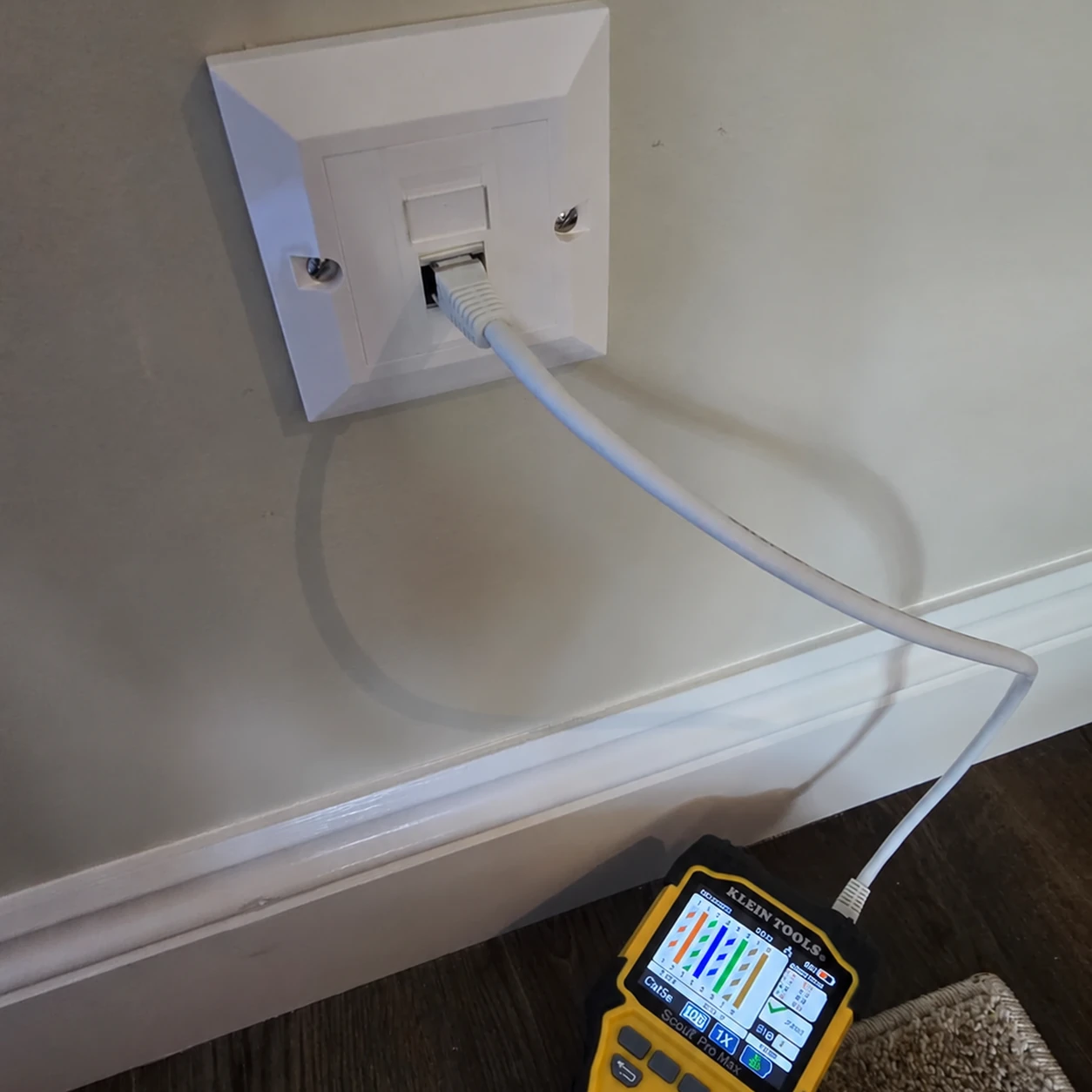
About 20m of Ethernet cable run in through the wall to a new network socket, for a gaming PC and a home office in the same room, tested end to end.
One cable to the back bedroom, or every room in the building — it is the same job to the same standard. We install network cabling in houses and in commercial premises across Yorkshire: a single run to get a desk, a console or a TV off WiFi, a handful of runs to feed access points properly, or a full wired installation landing back at one tidy central point. We use solid copper cable throughout, never copper-clad aluminium, and we agree the right grade of cable with you before we start, based on what the job actually needs.
/ When to call us
Need the switches, VLANs, firewall and business WiFi on top of the cabling? that is our business network service.
/ What you get
/ Our Process
Tell us the property, roughly how many runs you want and where they need to reach.
We agree routes and socket positions with you — over the phone where it is straightforward, on site where it is not.
Cables pulled, routed and fixed. A single run is often a half day; a whole property is usually one to two days.
Sockets fitted, the far end landed on a patch panel or labelled tail, every run marked at both ends.
Every run tested and handed over with a plan of what reaches where, so the next person is not guessing.
/ Investment
Every job is different, so final pricing is confirmed after a site consultation. The figures below are typical starting points to help you plan.
£140 + VAT
per run
A single cable run from your router to one room
Quoted
after site consultation
Several runs, or a whole property wired in one visit
Quoted
after site consultation
Adding a patch panel and cabinet so the runs land somewhere tidy
/ Recent jobs
Minskip
About 20m of Ethernet cable run in through the wall to a new network socket, for a gaming PC and a home office in the same room, tested end to end.
York
Ethernet cables run through the loft, linking the WiFi access points back to the network cabinet.
York
Ethernet cables for the WiFi access points run through the house via the loft, down the outside wall and in under the eaves, to a network switch in the loft.
Knaresborough
Four Ethernet cable points run back to a network wall cabinet in the attic.
/ Questions
Both, and genuinely equally. A single run to a home office is as welcome a job as a full commercial installation — it is the same cable, the same tools and the same standard of finish. If you have been reading our other pages and come away thinking we only work with businesses, that is a fault in how those pages were written rather than a limit on what we do.
Both are twisted-pair network cables and both will carry a gigabit comfortably over the distances in a normal building. Cat6a is thicker, better shielded and holds 10 gigabit over a longer run, which matters for backhaul between switches, longer commercial runs and anything you want to leave alone for fifteen years. Cat6 is thinner and easier to route through a tight domestic space. We do not commit to a grade before we understand the job — we agree it with you first, based on what the run actually has to do, and there is no sense selling you the dearer cable for a six-metre run to a bedroom. What does not vary is the copper: every run we install is solid copper, never copper-clad aluminium.
Copper-clad aluminium, usually sold as CCA, is a cheaper cable that looks identical from the outside. The core is aluminium with only a thin coating of copper on it. Aluminium carries electricity less well than copper, so the cable has higher resistance, runs warmer and loses more signal over the same distance. It is also more brittle, so it is easier to break while pulling it through a floor void and more likely to fail later at a termination. The problems show up worst on anything powered over the network cable — cameras, door entry, access points and desk phones — because that is where the current is highest. It is not what the cabling standards are written around. We use solid copper only, on every job, including the single-run ones.
Usually far less than people expect. Most runs go through a loft, under floorboards, through an existing service void or down the outside of the building in conduit, and come out through a single small hole behind the socket. Where there is genuinely no concealed route we will say so before starting and use paintable surface trunking, neatly run, rather than drilling a route that will not work. Nothing gets drilled until you have agreed where it goes.
For the room it reaches, yes, and it is not close. A wired connection does not share the air with your neighbours, does not halve its bandwidth relaying to another device, and does not drop when somebody puts the microwave on. The honest caveat is that a cable only fixes the room it goes to — if you want coverage everywhere, the usual answer is a cable feeding an access point, which is the two services working together rather than either on its own.
Either. A lot of our cabling work is a single run somebody has put off for years, and a lot of it is a full installation with every room landing back at one cabinet. The useful moment for the larger job is while a building is already open — a refurbishment, an extension or a loft conversion — because the routes are accessible and the making good is happening anyway.
/ Areas we cover
We're based in Knaresborough, so most of our work is close to home:
We also regularly work in Ripon, Skipton, Thirsk, Northallerton and the Lake District. Further afield? Get in touch and we'll tell you straight whether we can help.
/ Explore more
/ Get in Touch
Tell us about the property, the problem or the plan. We’ll come back with a clear scope and a written quote — usually within 24 hours.
Call us
01423 209018
info@geekfix.uk
Service area
Knaresborough · North Yorkshire · Yorkshire & beyond
1‑HOUR CALLBACK
Send this form during working hours and we’ll call you back within 60 minutes.