If your fibre line has been cut or snapped, the slowest part of getting back online usually isn't the repair — it's the wait. Call most providers and you're in a queue: an engineer gets dispatched in a few days, sometimes longer, and until then a business is losing trade by the hour and a household has no internet at all. But the fix itself — a clean fusion splice — takes minutes. This is a look at why fibre breaks, why the delay happens, and how having the right kit in-house changes the timeframe.
What actually breaks a fibre line
In our experience, most fibre faults aren't faults in the fibre — they're physical damage. The usual culprits are the same ones, over and over:
- Builders and contractors. A spade or a digger through a buried line during groundworks is one of the most common calls we get. The line often wasn't marked, or the plans didn't show it.
- Gardeners and landscapers. Edging a border, lifting a path, or digging a bed — a shallow-run fibre is easy to catch and doesn't take much to sever.
- Storm damage. A lot of UK fibre runs overhead on poles rather than underground, and British weather does what British weather does. High winds, falling branches and storm debris bring lines down or damage them, and that spikes every time we get a bad spell.
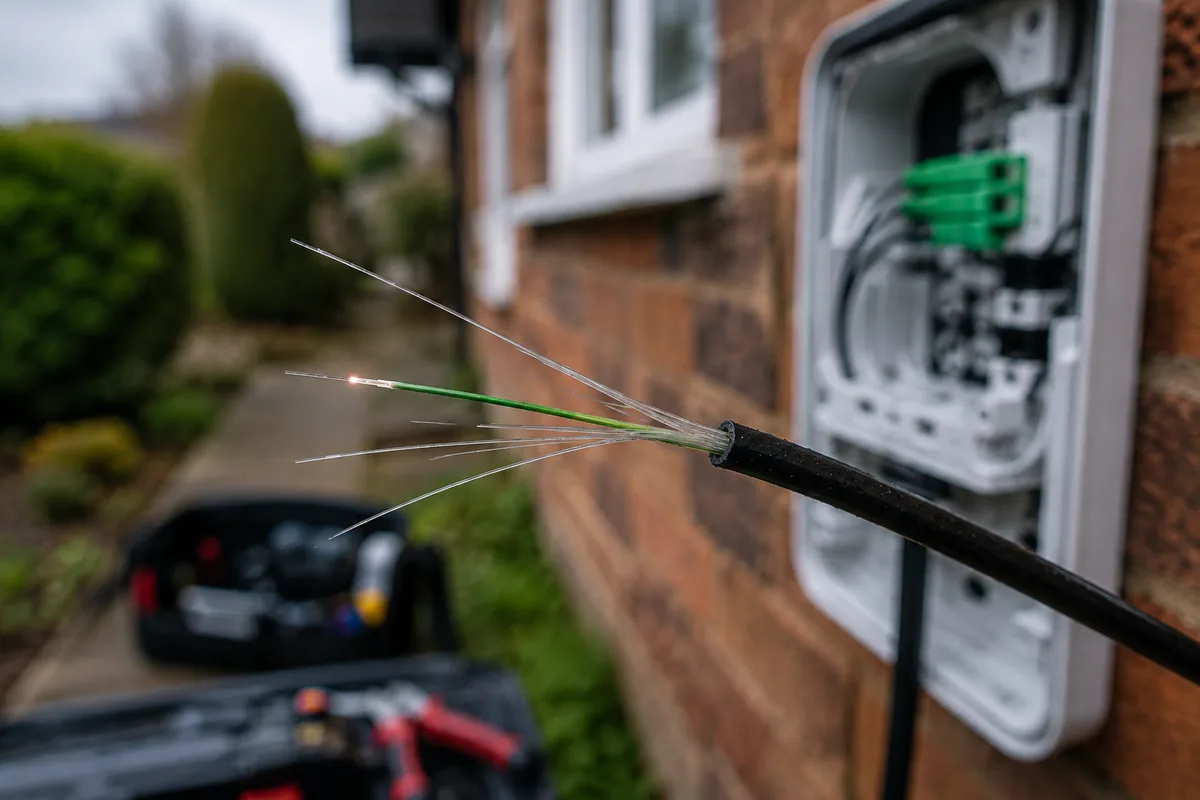
Whatever the cause, the outcome is the same: the glass fibre inside the cable is severed or crushed, and the light can't get through. That's not something you patch with tape — the fibre ends have to be rejoined precisely.
Why the wait, not the work, is the problem
Here's the part that surprises people: rejoining a fibre is fast. The reason a fibre repair can drag on for days has almost nothing to do with the repair and almost everything to do with scheduling. When the fix is outsourced or handled through a large provider, you're waiting for a specialist engineer to become available and be sent out. That dispatch queue is the delay — not the splice.
The splice itself, done properly, is a matter of minutes once someone's actually standing at the cable with the right equipment.
In-house fusion splicing — and why it matters
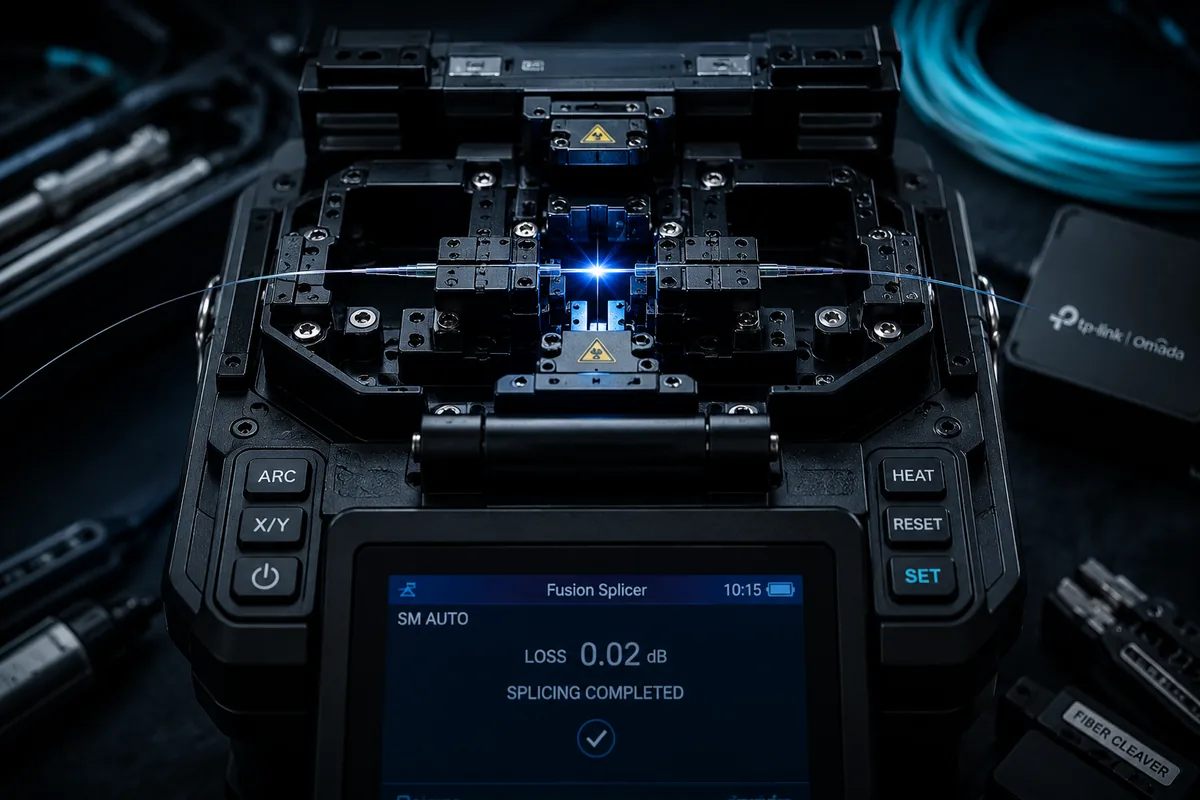
We run our own fibre fusion splicer. That's the machine in the photo at the top: it aligns the two bare fibre ends to within microns and fuses the glass together with a precise electrical arc, leaving a permanent, low-loss join. A good splice measures a tiny fraction of a decibel of loss — the one pictured came in at 0.02 dB, which is about as clean as it gets.
The important word is in-house. Most installers who offer fibre repair at all send the splicing out to a third party — which means another company, another schedule, another wait. Because we own the kit and do the work ourselves, the whole job stays with us from the moment we diagnose the break to the moment you're back online. There's no handoff and no queue of our own to sit in.
It's also worth knowing this is proper fusion splicing, not a mechanical or "cold" splice — the quicker method some use, which clips the fibre ends together rather than fusing them and tends to lose more signal and hold up less well over time. Fusing the glass is the method that lasts.
How fast is "fast"?
Honestly? It depends on the job and the day — so we won't pretend every repair is instant. But because we're not waiting on anyone else, we can move quickly, and for urgent cases we can often attend the same day. A business with a dead line and no trade coming through the door gets treated as the emergency it is. The fairest thing we can tell you is: call, describe what's happened, and we'll give you a straight answer on timing rather than a vague window.
What we repair
- Single-mode and multi-mode fibre
- Full-fibre (FTTP) runs
- Indoor and outdoor cabling, including the runs into and around a property
- Business and residential — from a severed line at a commercial unit to a damaged run into a house
Fibre repair is the lead, but we also install fresh fibre runs where they're needed — the same in-house capability, applied to new work rather than a fix.
What it costs
Fibre repairs start from £199.99 plus VAT. The final price depends on the specifics — how the line's been damaged, where it is, and what access the job needs — so we carry out a consultation and give you a written quote rather than a number plucked out of the air. You'll know the cost before any work starts, with no surprises added on afterwards.
When to give us a call
- Your fibre line has been cut, snapped or damaged and you're offline
- Your ISP has quoted days and you can't afford to wait
- A contractor or gardener has caught a line during work on your property
- Storm or weather has brought down or damaged an overhead run
- You want the repair done properly — a fused, low-loss join that lasts
Damaged line on a pole, or the run coming into the property? That's usually your provider's rather than yours. We can still repair it — here's what that means for you.
If any of those sound like your situation, book a consultation or take a look at our fibre installation and repair service. The break might have you stuck — the fix doesn't have to keep you waiting.